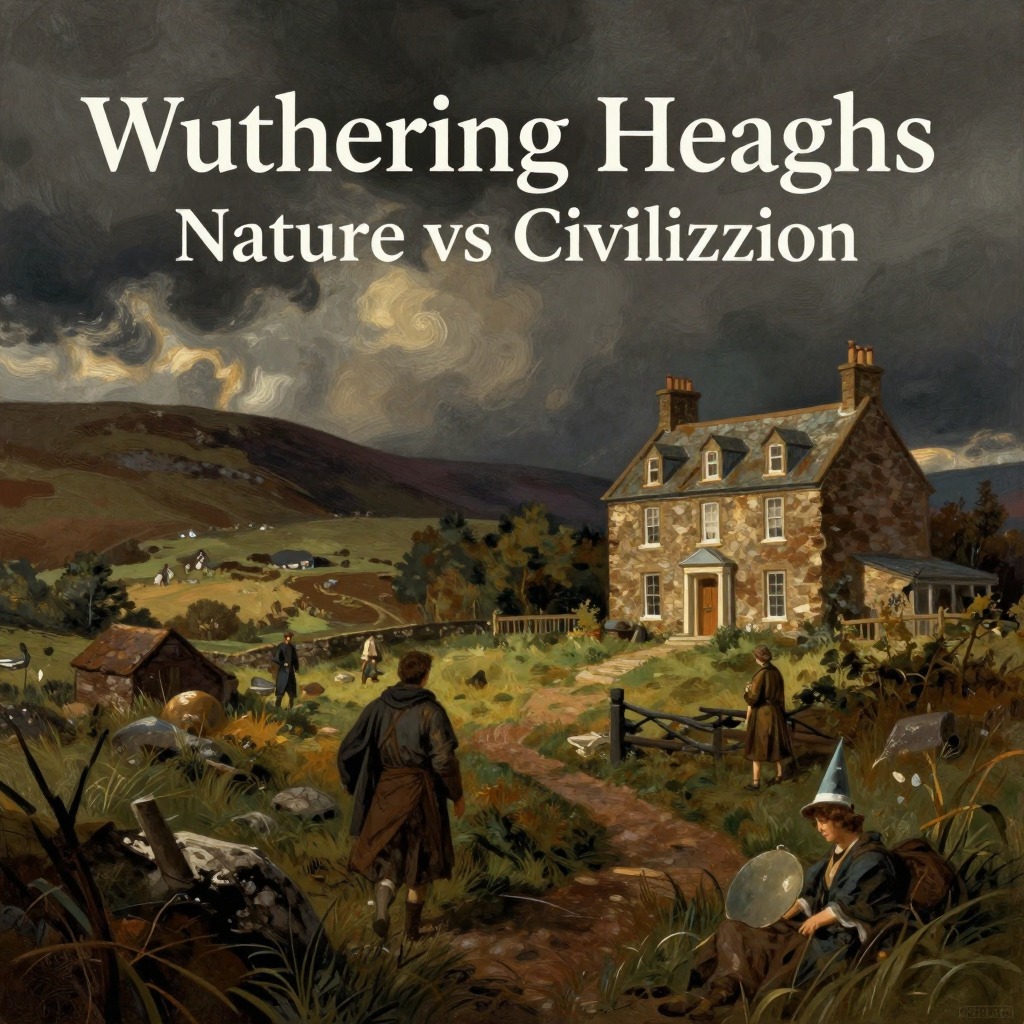
The Moors
The Moors are the vast, wild, and windswept heathland surrounding Wuthering Heights and Thrushcross Grange, functioning as the novel's central symbolic landscape. They represent freedom, raw nature, and the spiritual home of Catherine Earnshaw and Heathcliff, standing in stark opposition to the constraints of civilized society. The moors are the site of the characters' most intense experiences—childhood rebellion, passionate love, ghostly hauntings, and ultimate reconciliation—and their untamed character permeates the novel's atmosphere, plot, and thematic conflicts.
Geography and Atmosphere
The moors are defined by their exposure to violent weather. The name "Wuthering" is a provincial adjective describing "the atmospheric tumult to which its station is exposed in stormy weather," and the power of the north wind is evident in the "excessive slant of a few stunted firs at the end of the house" and "a range of gaunt thorns all stretching their limbs one way, as if craving alms of the sun." This harsh environment shapes the architecture of Wuthering Heights itself, built with "narrow windows" deeply set and corners "defended with large jutting stones." The landscape is treacherous: paths are easily lost in snow, and the deep swamps on either hand can be confounded with the firmer path during a fall. The moors are also a place of stark beauty, where the heather blooms and the air is pure and bracing, but their beauty is always tinged with danger and isolation.
The Realm of Freedom and Childhood
For Catherine Earnshaw and Heathcliff, the moors are the domain of their wild, unfettered childhood. Their chief amusement was to "run away to the moors in the morning and remain there all day," and the after punishment for such escapades grew "a mere thing to laugh at." The moors are the setting for their rebellion against Hindley's tyranny, a place where they can escape the oppressive rules of the house. Catherine's deepest longing, expressed during her delirium, is to return to this state: "I wish I were a girl again, half savage and hardy, and free; and laughing at injuries, not maddening under them!" She believes she would be herself again "were I once among the heather on those hills." The moors are thus the landscape of her authentic self, before she was "converted at a stroke into Mrs. Linton, the lady of Thrushcross Grange."
The Site of Haunting and Spiritual Connection
The moors are the liminal space where the boundary between the living and the dead becomes permeable. Catherine's ghost, after twenty years of wandering, appears to Lockwood in his dream, crying "I'm come home: I'd lost my way on the moor!" Heathcliff, in his grief, prays for her to haunt him, crying out "Be with me always—take any form—drive me mad! only do not leave me in this abyss, where I cannot find you!" He later describes how, after her death, he felt her presence on the moors: "When I walked on the moors I should meet her coming in." The moors become the stage for his obsessive communion with her spirit. Even after Heathcliff's death, local folklore insists that his ghost and Catherine's are seen walking the moors together, a belief that persists to the end of the novel.
The Arena of Conflict and Transformation
The moors are also the setting for key conflicts and transformations. It is on the moors that Heathcliff overhears Catherine say it would "degrade" her to marry him, a moment that precipitates his three-year disappearance and his subsequent transformation into a figure of calculated revenge. Later, the moors are where Heathcliff forces the young Catherine Linton to meet her cousin Linton, a prelude to her imprisonment and forced marriage. Yet the moors also witness the novel's redemptive turn. After Heathcliff's death, Hareton Earnshaw and Catherine Linton, the second generation, are seen walking on the moors together, their reconciliation signaled by their shared enjoyment of the landscape that once belonged to their parents' passion and pain.
Symbolic Significance
The moors embody the novel's central thematic opposition between nature and civilization. They are the wild, untamable force that resists the order and decorum of Thrushcross Grange. The characters who are most at home on the moors—Catherine and Heathcliff—are those who are most passionate, most authentic, and most resistant to social convention. The moors are the source of the novel's elemental power, a landscape that is both beautiful and terrifying, a place of freedom and of haunting, of childhood joy and of adult despair. They are, ultimately, the only place where the souls of the novel's most tormented characters can find a kind of peace, as suggested by the final image of the three headstones on the slope next to the moor, where the "sleepers in that quiet earth" rest undisturbed.